
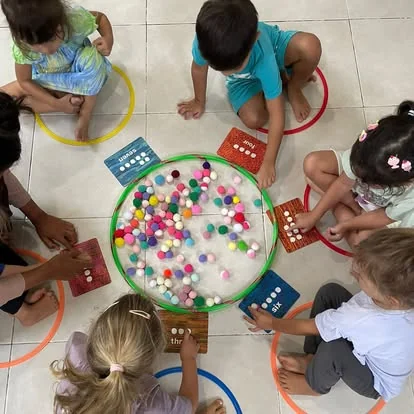
Play is one of the most natural ways young children learn.
When children build, pretend, explore, move, create, talk and experiment, they are doing much more than simply having fun. They are developing important skills that support their learning, confidence and development.
Play-based learning gives children opportunities to discover ideas for themselves while adults provide guidance, encouragement and suitable challenges.
1. Play Encourages Curiosity
Young children are naturally curious.
They want to touch, test, compare, move, build and find out what happens next.
Through play, children can explore questions such as:
- What happens if I stack these blocks higher?
- Which objects will fit inside this container?
- How can I make this structure stronger?
- What happens when I mix these colours?
- How can we solve this problem together?
These everyday discoveries help children develop curiosity and a positive attitude towards learning.
2. Children Learn Through Doing
Young children often understand ideas more easily when they can experience them directly.
For example, children can begin learning about numbers by counting objects, comparing groups, sorting materials and using numbers during games.
They can develop early literacy skills through stories, songs, conversations, role play, drawing and recognising familiar letters and words.
Hands-on experiences help make learning meaningful because children can connect new ideas with things they can see, touch and do.
3. Play Supports Communication
Play creates many natural opportunities for children to communicate.
During group activities and imaginative play, children may need to:
- explain what they are doing
- listen to other children
- ask questions
- describe ideas
- negotiate roles
- take turns
- solve disagreements
- learn new vocabulary
These experiences can help children become more confident expressing themselves and understanding others.
For children developing English, play also provides meaningful opportunities to hear and use language in real situations.
4. Play Develops Social Skills
Learning how to interact with other people is an important part of early childhood.
When children play together, they gradually learn how to share space, cooperate, wait, take turns and understand different points of view.
They also begin to recognise that other children may have different ideas, feelings and needs.
These experiences support social-emotional development and help children become more comfortable participating in a group.
5. Play Builds Problem-Solving Skills
Many forms of play naturally involve problems that children need to solve.
A tower falls over.
A puzzle piece does not fit.
Two children want the same toy.
A model does not work as expected.
Instead of immediately solving every problem for children, adults can encourage them to think, experiment and try different approaches.
This helps children develop persistence, flexibility and logical thinking.
6. Creative Play Encourages Imagination
Drawing, painting, construction, storytelling, music and pretend play allow children to create their own ideas.
There is not always one correct answer.
A cardboard box can become a house, a shop, a boat or a spaceship.
A collection of blocks can become a city, a bridge or something completely new.
Creative activities allow children to make choices, experiment and express themselves in different ways.
7. Physical Play Supports Development
Young children also learn through movement.
Running, climbing, balancing, jumping, throwing and catching help develop gross motor skills, coordination and body awareness.
Smaller activities such as drawing, threading, cutting, building and manipulating objects support fine motor development and hand-eye coordination.
These physical skills are important for many everyday tasks and later classroom activities.
8. Adults Still Have an Important Role
Play-based learning does not mean children are simply left to play without guidance.
Adults can support learning by:
- providing interesting materials
- asking thoughtful questions
- introducing new vocabulary
- observing children’s interests
- extending activities
- encouraging cooperation
- helping children reflect on what they discovered
The aim is to guide learning without taking control of every activity.
Children remain active participants in their own learning.
9. Play Can Include Literacy and Numeracy
Play-based learning and academic development are not opposites.
Early literacy and numeracy can be introduced naturally through meaningful activities.
Children might count plates while playing restaurant, recognise letters during a treasure hunt, compare sizes while building or practise writing during pretend shop play.
These experiences help children understand why numbers, language and communication are useful.
10. Positive Experiences Build Confidence
When children are interested and involved in an activity, they are more likely to keep trying.
They learn that mistakes are part of discovering how things work.
They also experience the satisfaction of completing something, solving a problem or learning a new skill.
These positive experiences can help children become more confident and willing to try unfamiliar activities.
Learning Through Play at Shining Stars
At Shining Stars School Kamala, play is an important part of early learning.
Children have opportunities to explore, communicate, create, move, solve problems and develop new skills through age-appropriate activities and experiences.
Our aim is to help children build confidence, curiosity and a positive relationship with learning.
Learn ★ Play ★ Grow
Looking for a preschool or kindergarten in Phuket?
Shining Stars School Kamala provides English-intensive, play-based learning for children ages 2–7 in a caring environment with individual attention.
Contact Shining Stars