
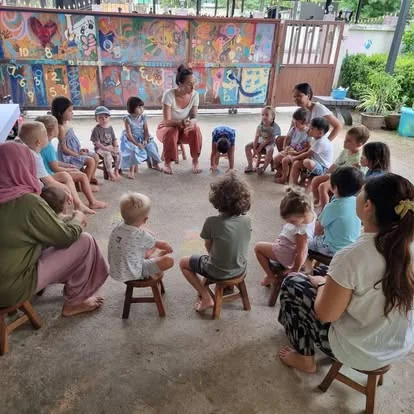
Young children have a natural ability to listen, imitate, experiment and learn through everyday experiences. When English becomes a regular part of their learning environment, they have frequent opportunities to become familiar with the language in a natural and positive way.
English immersion for young children is not about memorising long vocabulary lists or completing endless language exercises. It is about hearing and using English while playing, talking, singing, listening to stories, following routines and interacting with other people.
For preschool and kindergarten children, these meaningful experiences can help make English part of everyday communication rather than simply another subject to study.
1. Children Learn English Through Everyday Experiences
Young children learn a great deal from what happens around them.
During a normal day, there are many opportunities to hear and understand English. A teacher might ask children to put away their toys, choose a colour, count objects, wash their hands, sit together for a story or describe something they have made.
Because the language is connected to an action or situation, children can begin to understand meaning from context.
Over time, frequently heard words and expressions become increasingly familiar.
This helps children experience English as a practical means of communication.
2. Regular Exposure Builds Familiarity
Learning a language takes time.
Young children benefit from hearing English regularly rather than encountering it only occasionally.
Repeated exposure allows children to hear the same words, phrases and sentence patterns in many different situations.
For example, words relating to colours, numbers, shapes, feelings, movement and everyday objects may appear during:
- classroom activities
- games
- songs
- stories
- creative projects
- conversations
- daily routines
This repetition can gradually strengthen understanding without requiring children to memorise everything at once.
3. Listening Comes Before Confident Speaking
Children do not always begin using a new language immediately.
A child may spend considerable time listening and observing before feeling comfortable enough to answer in English.
That is a normal part of language development.
During this period, children may already understand considerably more English than they actively use.
Giving children time to listen without placing unnecessary pressure on them can help create a more positive experience.
As their familiarity increases, individual words can gradually become short phrases, questions and conversations.
4. Play Creates Natural Reasons to Communicate
Play provides many opportunities for children to communicate.
When children build something together, participate in imaginative play, complete a puzzle, play a game or work on a creative activity, language has a real purpose.
They may need to:
- ask for something
- explain an idea
- answer a question
- describe what they are doing
- take turns
- solve a problem together
- listen to another child
English can therefore become connected with enjoyable and meaningful experiences.
Children are not simply practising English. They are using language to participate in what is happening around them.
5. Songs and Stories Support Language Development
Songs, rhymes and stories are particularly useful for young language learners.
Songs introduce repetition, rhythm and predictable language patterns. Children can participate even when they do not yet understand every word.
Stories introduce children to a wider range of vocabulary and sentence structures.
Pictures, expressions, gestures and the events in a story can also help children work out meaning.
When favourite stories and songs are repeated, children often begin anticipating familiar words and phrases.
This can make learning English enjoyable while strengthening listening and comprehension.
6. English Can Support Communication Confidence
Using another language requires more than knowing vocabulary.
Children also need the confidence to try.
A supportive environment gives children opportunities to experiment with language without worrying about making every sentence perfect.
They can listen, copy expressions, ask questions and gradually attempt more independent communication.
Positive responses from teachers and other children can encourage them to keep participating.
The objective is not perfect English from the beginning. It is helping children become increasingly comfortable communicating.
7. Learning With Other Children Adds Meaning
Children learn a great deal from one another.
During group activities and play, they hear how other children communicate and observe how language is used in different situations.
They may repeat words they hear, respond to simple questions or discover new ways of expressing an idea.
Group interaction also means communication is not limited to conversations between a teacher and an individual child.
English becomes part of the wider social environment.
This can help connect language development with important social skills such as listening, sharing, cooperation and taking turns.
8. English Can Be Integrated With Other Learning
Language learning does not need to happen separately from the rest of a child’s development.
English can be naturally incorporated into early literacy, numeracy, science, creative activities, movement and problem-solving.
Children might count objects in English, describe colours while painting, talk about shapes while building or discuss what they observe during an activity.
This means children can develop language while exploring other ideas and skills.
The language has context, which can make new words and concepts easier to understand.
9. A Positive Experience Matters
Young children learn best when they feel comfortable enough to participate, explore and make mistakes.
For this reason, the emotional experience surrounding language learning matters.
If English is associated with enjoyable activities, interesting stories, supportive adults and positive interaction with other children, children have good reasons to engage with it.
They do not need to understand every word immediately.
Progress develops gradually as children listen, participate and become increasingly familiar with the language.
10. Parents Can Support English at Home
Parents do not need to recreate a classroom at home.
Simple and enjoyable exposure can complement what children experience at school.
Depending on the family’s language background, this could include:
- reading suitable English picture books together
- listening to children’s songs
- talking about familiar objects or pictures
- counting during everyday activities
- playing simple language games
- asking children about words or songs they have learned
- encouraging rather than correcting every mistake
It is also important for families to continue valuing the languages already spoken at home.
Developing English does not require parents to stop communicating naturally with their children in their home language.
English Learning as Part of Everyday Childhood
For young children, English immersion can be most meaningful when language is connected with real experiences.
Play, stories, songs, conversations, routines and shared activities give children repeated opportunities to listen, understand and communicate.
Some children will begin speaking English quickly. Others may spend longer listening before they feel ready to participate verbally.
What matters is providing regular opportunities to experience English in a supportive environment where children can develop at an appropriate pace.
At Shining Stars School Kamala, English-intensive learning is combined with play-based experiences, individual attention and opportunities for children to communicate, explore and learn together.
Learn ★ Play ★ Grow
Looking for a preschool or kindergarten in Phuket?
Shining Stars School Kamala provides English-intensive, play-based learning for children ages 2–7 in a caring environment with individual attention.
Contact Shining Stars